Choosing a Vacuum for a Bend Home
Vacuum reviews rank machines on suction, and suction is the wrong headline number for Central Oregon. The dominant soil here is extremely fine mineral particulate, and the question that matters is whether your vacuum keeps it or gives it back.
Sealed HEPA filtration matters more than raw suction in a high-desert home. Crushed basalt and volcanic cinder break down to a particle size that ordinary vacuum filters pass straight through, so an unsealed machine collects dust at the floor and exhausts it into the air you breathe.
Why filtration beats suction here
book a Bend carpet cleaner. Without sealed filtration, a proportion of that particulate travels through the motor housing and out of the exhaust port, which redistributes it around the room rather than removing it.
The word that matters on the box is sealed. Many machines advertise a HEPA filter while allowing air to bypass it through gaps in the body. The filter is genuine; the sealing is not, and unfiltered air takes the easiest route.
What to look for
| Feature | Why it matters in Bend | Priority |
|---|---|---|
| Sealed HEPA system | Fine mineral dust otherwise re-enters the room | Essential |
| Adjustable height | Lets the head sit correctly on different pile depths | High |
| Beater bar with off switch | Needed on cut pile, harmful on loop and rug fringe | High |
| Bagged collection | Contains fine dust at disposal instead of releasing it | Preferred |
| Strong airflow rating | More relevant than peak suction for deep particulate | Moderate |
| Crevice and upholstery tools | Edges and filtration lines need direct treatment | Moderate |
Bagged versus bagless
Bagless is more convenient and cheaper to run. It also releases a cloud of the finest particulate every time you empty it, which in a home carrying volcanic dust means redistributing exactly what you just collected.
If you have allergies, or if the household includes anyone with asthma, bagged collection is the better choice for a reason that has nothing to do with cleaning performance and everything to do with disposal.
Technique changes the result more than the machine
- Slow down. Airflow needs contact time. Two slow passes remove considerably more than six fast ones.
- Change direction. Pile lies in one direction and traps particulate against the lean. Cross-directional passes reach what a single direction misses.
- Do edges deliberately with a crevice tool. Filtration lines along baseboards will not respond to a full-width head bridging over them.
- Prioritise entry lanes. The first three metres inside each exterior door carry most of the abrasive load.
- Set the height correctly. A head set too low seals against the carpet and kills airflow; too high and it never engages the pile.
What a domestic vacuum cannot do
even a good machine has limits. Grit that has been driven to the base of the pile and into the backing sits below what domestic airflow reaches, and in Central Oregon that is where the abrasive damage happens.
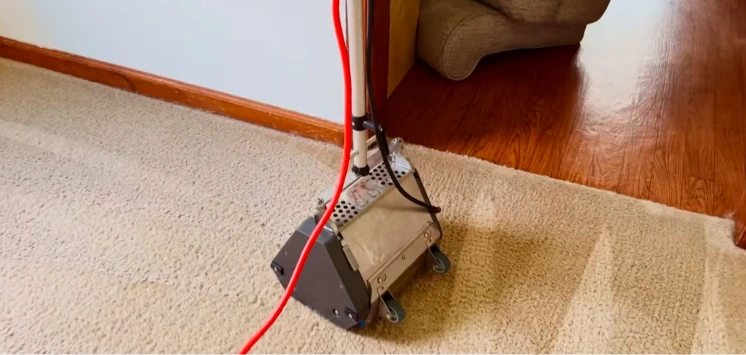
That is the argument for periodic commercial dry pre-vacuum followed by extraction, rather than an argument for buying a more expensive vacuum. The two do different jobs, and the household machine is doing maintenance rather than removal.
Frequently Asked Questions
What vacuum is best for a Bend home?
One with sealed HEPA filtration rather than the highest suction number. Volcanic cinder dust breaks down to a particle size that unsealed machines exhaust back into the room after collecting it from the floor.
Is bagged or bagless better for fine dust?
Bagged, if anyone in the household has allergies or asthma. Bagless emptying releases a cloud of the finest particulate, which redistributes exactly the material you collected.
Should I use a beater bar?
On cut pile yes, it agitates the pile so airflow can reach deeper. On loop pile, Berber and rug fringe, no — a rotating brush can catch loops and pull structural threads.
How slowly should I vacuum?
Slower than feels necessary. Airflow needs contact time to lift particulate from the pile, so two slow passes remove considerably more than six fast ones.
Can a good vacuum replace professional cleaning?
No, they do different jobs. Domestic vacuums handle surface and near-surface particulate. Grit driven to the base of the pile and into the backing sits below what domestic airflow reaches, and that is where abrasion happens.
Vacuum not keeping up? We reset the baseline.